How to find the owner of a vehicle in Tennessee?
How to find the owner of a vehicle in Tennessee?
If you are a driver in Ohio, you likely share the road with vehicles from all over the country. Given the proximity, it is common to encounter cars, trucks, and motorcycles from Tennessee on I-75 or I-71. While most of these interactions are passing glances, there are moments when identifying the owner of a specific vehicle becomes a matter of necessity rather than curiosity.
Perhaps you were involved in a minor fender bender in Cincinnati with a Nashville-based driver who refused to exchange information. Maybe you are looking to purchase a used car that was titled in Tennessee, and you want to verify the seller’s identity. Or perhaps a vehicle with Volunteer State plates has been abandoned on your private property for weeks.
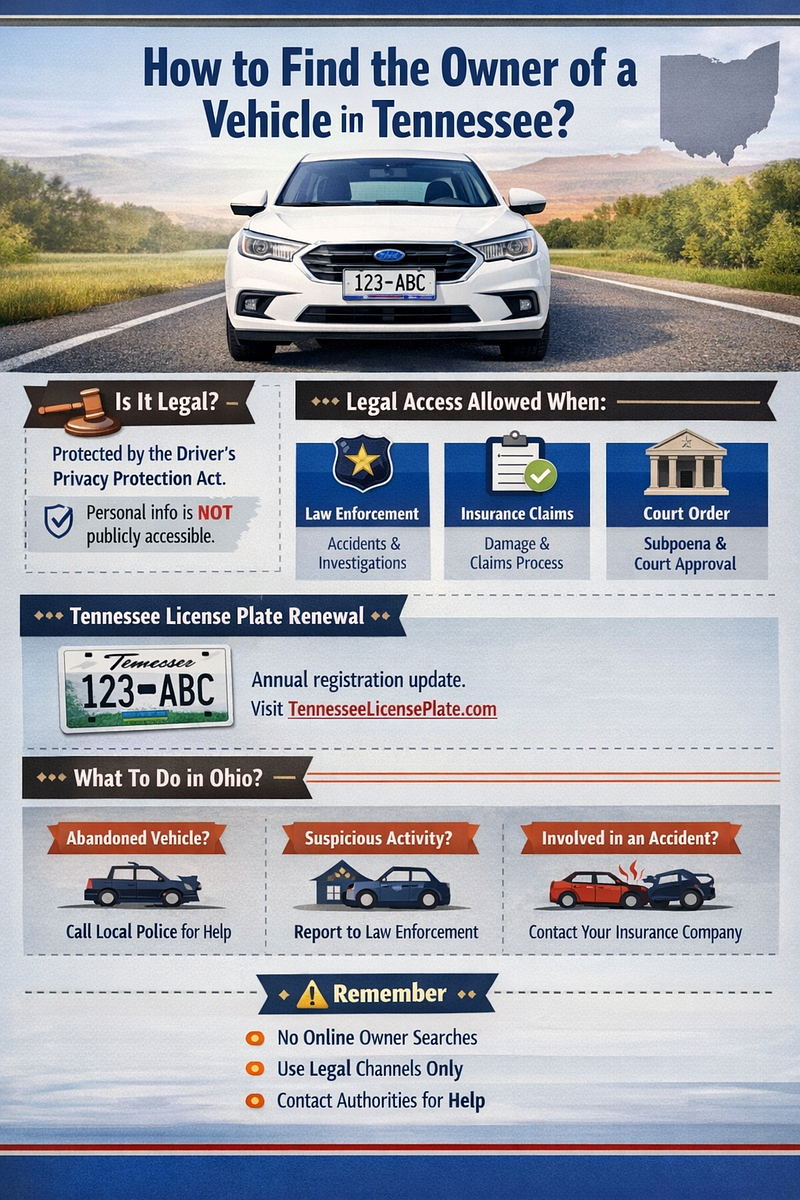
In these situations, your first instinct might be to write down the license plate number and search for it online. However, finding the registered owner of a vehicle in Tennessee is not as simple as a quick Google search. Privacy laws are strict, and the Tennessee Department of Revenue (DOR) guards this information carefully.
This guide will walk you through the legal methods available to find a vehicle owner in Tennessee, the specific forms you need, and how to navigate the privacy laws that protect this data.
The Hurdle: Understanding the Driver’s Privacy Protection Act (DPPA)
Before diving into the “how-to,” it is critical to understand why this information is hard to get. In the past, vehicle registration records were often public domain. Anyone could walk into a DMV, pay a small fee, and get the name and home address associated with a license plate.
That changed in 1994 with the federal Driver’s Privacy Protection Act (DPPA). This law was enacted to protect the personal information of drivers from stalkers, criminals, and unauthorized marketers. Tennessee has adopted these federal standards into state law.
Under the DPPA, “personal information” includes:
- Names
- Addresses
- Telephone numbers
- Social Security numbers
- Photographs
This means that the Tennessee Department of Revenue cannot release the owner’s name to just anyone who asks. You must have a “permissible use” to access this data. If you are just curious about who drives that cool vintage Mustang you saw in Columbus, you are out of luck. However, if you have a legitimate legal or safety reason, the state provides a pathway for you to obtain the records.
What Qualifies as a “Permissible Use”?
To legally request vehicle owner information in Tennessee, your reason must fall into one of the specific categories allowed by the DPPA. Common permissible uses include:
- Legal Proceedings: For use in connection with any civil, criminal, administrative, or arbitral proceeding in any court or government agency. This includes the service of process or investigation in anticipation of litigation.
- Insurance: For use by any insurer or insurance support organization in connection with claims investigation activities, antifraud activities, rating, or underwriting.
- Towing and Impoundment: For use by a government agency or private person (like a tow truck operator) to provide notice to owners of towed or impounded vehicles.
- Vehicle Safety and Recalls: For use by a manufacturer or government agency to notify owners about safety recalls or advisory notices.
- Private Investigation: For use by a licensed private investigator or security service, provided they are using the information for one of the other permitted purposes (like a legal case).
If your situation fits one of these criteria, you can proceed with a formal request.
Method 1: The Official Route (Tennessee Department of Revenue)
The most reliable way to find the current registered owner of a vehicle is to request the record directly from the Tennessee Department of Revenue (DOR), Vehicle Services Division.
Step 1: Identify the Vehicle
You will need as much information as possible to ensure the search is accurate. At a minimum, you need the Vehicle Identification Number (VIN) or the License Plate Number.
Step 2: Download the Request Form
You must complete the Vehicle Information Request (Form RV-F1313801). This form acts as a sworn statement. By signing it, you are certifying that you have a permissible use under the DPPA. Lying on this form is a crime and can result in significant fines and legal trouble.
Step 3: Complete the Form
The form requires you to:
- Provide your personal or business details.
- Check the box for the specific information you are requesting (e.g., “Current motor vehicle record” or “Complete history of vehicle”).
- Select your “permissible use” from the list of legal options.
- Provide the VIN or Tag Number of the vehicle in question.
Step 4: Pay the Fee
Tennessee is surprisingly affordable regarding records requests compared to other states.
- Computer printout of vehicle record: $1.00 per record.
- Certified computer printout: $1.50 per record.
- Photocopies of documents: $5.00 per record.
Make your check or money order payable to the Tennessee Department of Revenue. Do not send cash if you are mailing the request.
Step 5: Submit the Request
Mail your completed form and payment to:
- Tennessee Department of Revenue
- Vehicle Services Division
- 500 Deaderick Street
- Nashville, TN 37242
Note for Ohio Residents: If you are mailing this from Ohio, allow extra time for postal delivery and processing. Government agencies generally take 7 to 14 business days to process these requests, not including shipping time.
Method 2: Private Investigators (The Best Option for Legal Matters)
If you are an Ohio resident dealing with a complex legal matter involving a Tennessee vehicle — such as a hit-and-run, a custody dispute involving a vehicle, or a significant debt collection — hiring a private investigator (PI) is often the most efficient route.
Private investigators have access to commercial databases that are not available to the general public. While they still must adhere to DPPA laws, their licensure grants them a “permissible use” status that streamlines the process. A PI can often retrieve owner information in a matter of hours or days, whereas a mailed request to the state could take weeks.
Furthermore, a PI can verify if the address on file is current. Vehicle registration databases are not always perfectly up to date. If a person moves and fails to update their registration, the state’s data might lead you to a dead end. A PI has the tools to cross-reference utility bills, voter registration, and other data points to find the actual person, not just the name on the title.
The Role of Accurate Data and Registration
When you search for a vehicle owner, you are relying on the integrity of the state’s database. The accuracy of the result depends entirely on whether the vehicle owner has remained compliant with state laws.
In Tennessee, vehicle registrations expire annually. To keep a vehicle legal, the owner must complete their Tennessee license plate renewal every year. During this process, owners are required to verify their address and insurance information. If the owner has been diligent with their renewal, the information you receive from the Department of Revenue will be accurate.
However, if the vehicle has been sitting abandoned or the owner is avoiding the law, they may have skipped their Tennessee license plate renewal. In this case, the address on file might be years old. This is a common issue with “skip tracing” (finding people who don’t want to be found). If the tags are expired, the DMV record will give you the last known owner and address, which gives you a starting point but perhaps not the final answer.
Method 3: Third-Party Online Lookup Services
If you search “Tennessee license plate lookup” online, you will find dozens of websites promising to reveal the owner’s name for a small fee. Proceed with caution.
Most of these sites are “aggregate” data providers. They buy bulk data from various sources, but they do not have real-time access to the Tennessee Department of Revenue’s live database due to DPPA restrictions.
Often, these sites can provide:
- Vehicle Specs: Make, model, year, and engine type.
- Vehicle History: Accident reports, flood damage, and title branding (salvage, rebuilt).
- VIN Decoding: Verifying that the VIN matches the car you see.
However, they will rarely give you the current owner’s name and address unless you qualify for a DPPA exception and the site is a licensed consumer reporting agency.
If you are simply trying to verify what kind of car it is (for example, to confirm the car you are buying matches the description), you don’t need the owner’s name. You can use resources like Tennessee License Plate to understand more about the vehicle’s background or decode the information on the plate itself without violating privacy laws. These tools are excellent for general research but cannot replace the official DOR request for sensitive personal data.
What If You Are an Ohio Resident Buying a Tennessee Car?
A common scenario for Ohioans is crossing the border to buy a used car in Tennessee. You want to ensure the person selling the car actually owns it.
In this case, you do not need to file a records request. Instead, ask the seller to show you the Certificate of Title. Check the following:
- Name Match: The name on the title must match the seller’s ID.
- VIN Match: The VIN on the title must match the VIN on the dashboard and the door jamb of the car.
- Lienholder: Look at the front of the title. If a bank is listed as a lienholder, the seller cannot legally sell the car to you unless the lien has been signed off or released.
If the seller refuses to show the title or claims “it’s coming in the mail,” walk away. You cannot verify ownership without that document, and you risk buying a stolen vehicle.
Summary: Which Path Should You Take?
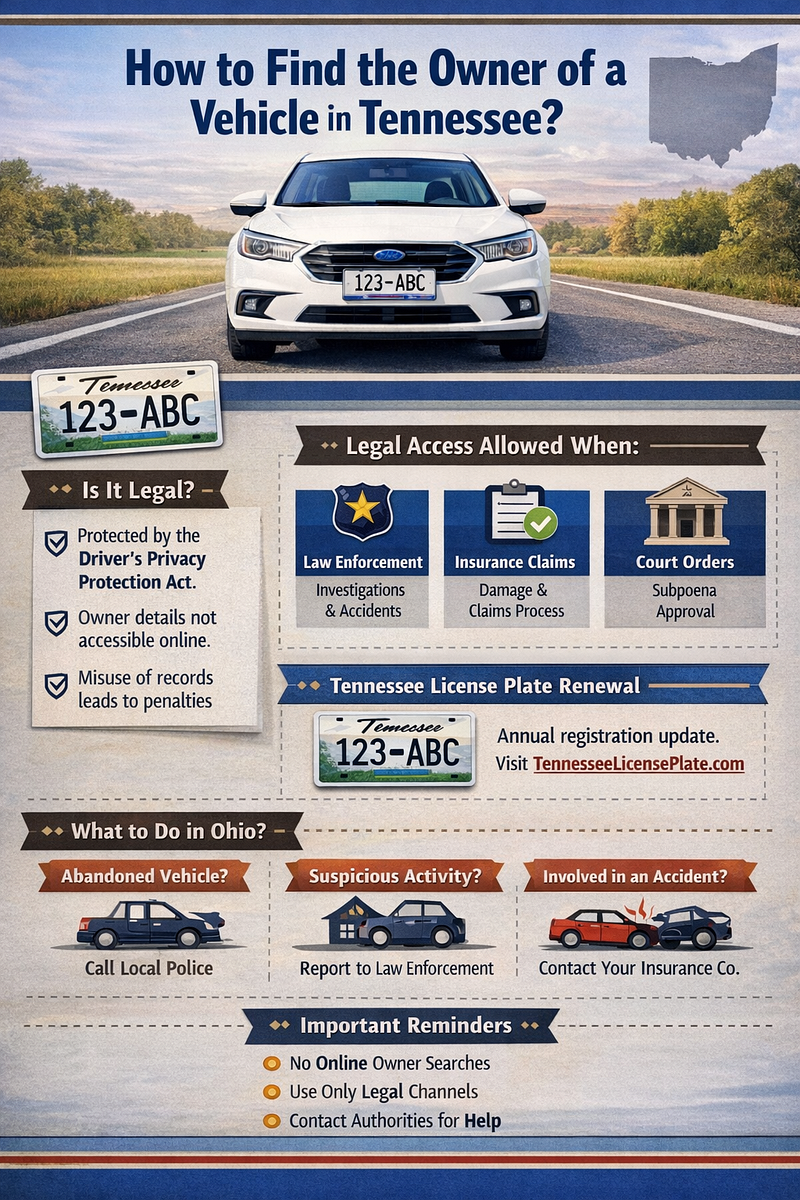
Finding a vehicle owner is a process designed to be difficult for the sake of privacy. Here is a quick summary of which path to take based on your situation:
- If you were in an accident: Call the police. The accident report will contain the other driver’s insurance and ownership details. This is the fastest and only free method.
- If you have a legal claim (lawsuit, debt): Use Method 1 (DOR Request Form RV-F1313801) or Method 2 (Private Investigator).
- If you are buying a car: Demand to see the physical Title and verify the VIN.
- If you are just curious: You cannot legally obtain the owner’s name.
By following the proper channels, you ensure that you get the information you need without violating state or federal privacy laws. Whether you are in Cleveland, Columbus, or Cincinnati, the process remains the same: respect the law, use the correct forms, and ensure your reasons are valid.